Categories
Heartache and Hope

Risking Love

Jess and Gina

I didn’t know how to tell her. I knew Jessie would be devastated. How do you share with an eight-year-old girl that another one of her friends has died?

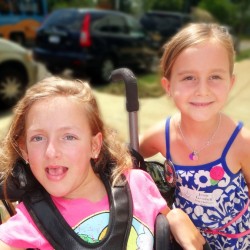
Gina Rugari, a fifteen-year-old girl from Ohio with Krabbe Disease, had clearly carved out a very special place in Jessie’s heart. Jessie would talk about Gina regularly; she would make her special gifts, she would write about her in her composition journal for school, and she waited with anticipation to see her each summer. When the two of them were together at the Hunter’s Hope Symposium, Jessie was practically glued to Gina’s side.

GinaA couple months ago, I discovered on Jessie’s wall a piece of her artwork that read, “I wish I lived near Gina.”  My heart swelled as I considered Jessie’s love for her special friend.  So in March, Gina’s mom Anne and I decided to set up a video conference call for the two of them. Though their time on the phone was brief, Jessie lit up at the chance to connect with her friend; little did we know that would be the last experience they’d share together.

Hence, how do you share with your little girl that her friend Gina has passed away?

That evening, when the three of us were together, I sat Jessie on my lap and said, “I have something difficult to share with you.” Jessie’s eyes immediately grew glassy and sad, as if she already knew.  “Sweetie,” I hesitated, “Gina passed away today.”

My little girl burst into tears. Weeping. “No, no, no,” she cried. “I don’t want Gina to die.”

We wept with her. We held her. She grieved. We grieved. In time, she fell asleep, weary of sorrow. Later that night, I couldn’t help but wonder aloud to Drake, “What does this do to her little soul?” There were no answers, just weighty prayers for her developing heart.

Jessie has been intermittently in the throes of grief since learning of Gina’s passing; she has mentioned several times how much her heart hurts.  She’s been struggling to sort out all she feels and put her heartbreak into words.

Jessie and TenleyAs we were having lunch together yesterday she was deep in thought when she contemplatively shared, “Mama, I really want to be friends with Tenley, but I’m afraid.” Tenley is another little girl with Krabbe disease for whom Jessie has special affection.

“Are you afraid to lose her?” I asked.

“Yeah,” she replied. “I know she will be having that hip surgery-thingy and what if…” her words trailed off, not wanting to complete the thought.

“Jessie, it makes sense that you’d be afraid. It hurts deeply when we lose someone we love. And I know you’ve experienced so much loss. I’m so sorry!” I lamented with her.  I paused, then asked, “I’m wondering…would you rather not have known Gina so you wouldn’t have to feel …”

I didn’t have to finish the question before she solemnly answered, “No. I had so much fun with Gina.”

“Gina brought joy to your life, didn’t she?  It was special to have her as a friend, wasn’t it?”

“Yeah,” she smiled at the thought.

“Pain is often part of love, Jess. But I believe the love is worth it. I’ve felt similar fears, but I’ve been learning that the pain never outweighs the gifts that come from choosing to love. ”

Every love involves risk. Sometimes the risks are especially apparent. And sometimes the person risking love is only eight.Gina and Jess 2


Categories
Heartache and Hope

The Cracked Code

Worn Bible

The pinnacle pursuit of our culture is to be happy. The meaning of life is frequently described as achieving a state of happiness and oftentimes the parental role has been reduced to a means of simply guiding our children into happiness. The pursuit of happiness is even written into the fabric of American government as an inalienable right to be protected. We’re a people who want to be happy.

But what does it mean to be happy? And what happens when life’s circumstances are anything but happy? When my son Jud died, I found my soul bristling at the idea of happiness; it seemed to lack substance, negate the weightiness of life’s challenges, and diminish the dynamic nature of our emotions into an ethereal state of consciousness.

So when I was reading the news last night, I was immediately intrigued by an article indicating how “Researchers Have Cracked the Code to Being Happy.” The Mayo Clinic, one of the world’s most renowned health organizations likely spent millions and millions of dollars, over several decades, to study the concept of happiness. Yet I found it fascinating that their “cracked code” is basically a reiteration of Biblical principles, outlined by our Creator thousands of years ago, as a guide for authentic joy and contentment.

A prominent psychologist, John Tamerin, is quoted in the article as saying that the root of happiness that people are chasing—a better job, more money or true love—is an endless pursuit that often backfires. “If you lead your life always waiting for a great thing to happen, you probably will be unhappy,” Tamerin asserted. Genuine happiness cannot be dependent on circumstances.

So what is the cracked code to being happy?

Think on These Things

First, Mayo Clinic experts assert that “If we learn to command our thoughts, shifting perspective away from the negative, and embrace the positive, we will be happier.”

Interestingly, God encourages us to do just that; He urges us to focus our thoughts on “whatever is true, whatever is noble, whatever is right, whatever is pure, whatever is lovely, whatever is admirable.” He invites us into a peace that transcends our circumstances by calling us to think about that which is excellent or praiseworthy (Phil 4:8).

Resilience

Second, the Mayo Clinic research indicates that “the degree of happiness people enjoy has to do with how resilient they are to life’s many curve balls.” Once again, the article acknowledges that happiness cannot be reliant on our external situation but is a matter of how we deal with challenges.

The Bible describes this kind of resiliency; “We are afflicted in every way, but not crushed; perplexed, but not driven to despair; persecuted, but not forsaken; struck down, but not destroyed” (2 Corinth. 4:8-9)  This resiliency arises out of God’s work in us and the understanding that He has a purpose and a plan, no matter what we face.

The Interests of Others

Third, the article claims that “one of the biggest hindrances to being happy is too much thinking about one’s self.”

Surprise, surprise! God told us that from the get-go: “In humility value others above yourselves; do not look to your own interests but each of you to the interests of the others.” (Phil 2:3-4) Focusing on the needs of others rather than our own, can, indeed, bring deep joy. In fact, the Bible states that our joy can be made complete by keeping God’s command to love others just as He has loved us (John 15:11-12).

Gratitude

The article concludes by stating that “complainers are never going to be happy.” Gratitude is key. One of the best ways we can reshape our perspective is by seeking ways to be grateful, whatever we face. Maybe this is why God encourages us to be thankful in all circumstances (Thes. 5:18).

The life of faith, to which God calls us, is the genuinely happy life. He created us. He loves us. He knows what is best for us. The keys to lasting happiness, true joy and contentment, were written 2000 years ago…researchers didn’t need to spend millions of dollars and decades of time because the code didn’t need to be cracked.


Categories
Heartache and Hope

When You Show Up

Judson's Memorial Service

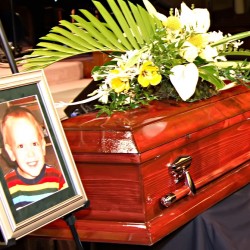
I’ve heard people describe how days like these can be a blur with an existential feeling of hovering above the experience rather than being central to it—I certainly encountered this at our son’s memorial service; much of the day felt illusory and impossible to fathom, as if reality had been suspended. But there is something etched in my memory, even seven years later. I remember the faces. I remember who was present. I can recall the tears, the hugs, the gentle touches, the sensitive smiles…the love. I may not remember the words people spoke to me, but I remember who was there to speak them.

I lucidly recall who forfeited their usual Monday to enter the devastation of death with our family and to honor our son that hallowed day in November. For many it wasn’t convenient, it wasn’t easy, they had to cancel plans, they had to make arrangements, they had to travel distances. But they did. And I remember…because it meant everything to me.

Last month Drake and I attended two separate memorial services for little girls who lost their lives to Krabbe Disease. We hopped on a flight to Kentucky to honor Anna and then two weeks later found ourselves on another plane to Montreal, Quebec to honor Lauren. We wanted to be there—because we remember—we remember the value of presence in that moment.

Of course memorial services draw Drake and I back into our own experience of loss and kick up excruciating memories, and they are by nature emotionally taxing, but that wasn’t the essence of our experience on these trips; they were, in fact, incredibly life-giving. I found myself in awe of the privilege to be present with these families during their darkest hours.  I found myself feeling honored to be invited into their grief and pain. I found my heart and soul being transformed by the opportunity to enter their world. This was real life when so much of the day-to-day can lack substance and depth. It was a gift to be present.

Our dear friends from Texas were visiting this weekend; these are friends who had hopped on a plane to be present with us when Jud died. They asked about the memorial trips we took last month. As I was sharing with them about the profound sense of honor and privilege we experienced by being invited into the lives of these families gripped by the loss of their child, our friend interrupted me with tears in her eyes and a weightiness to her words, “Christina…that is exactly how we felt. We were so blessed to be invited into your pain and be present with you at that time.”

I choked back tears. “Thank you,” I cried, “Thank you for being there.”

And therein lies this beautiful paradox; when we make the sacrificial choices to engage the mess, to respond to the call, to enter the dark places of someone else’s world, we find unimaginable blessings that can only arise from being present. We discover the grace and beauty found in the the most painful, raw corners of life.

So when you show up to the hospital, or the memorial service, or enter into the center of someone’s pain, your presence will be remembered, and quite possibly you might be surprised by the life-giving gifts that can only come from being present.


Categories
Heartache and Hope

Lauren’s Song

Lauren in my Lap

A window of opportunity had opened, so I tentatively asked, “Can I hold her?”

“Well, you can sure try, but she doesn’t always take well to strangers,” Amanda cautioned. This is a phrase commonly expressed by moms of infants or toddlers when someone asks to hold their baby, but in this circumstance, it was unusual.

It was the summer of 2012 and I was asking to hold Lauren Loughheed, Amanda and Stephen’s 18-month-old daughter who had been diagnosed with Krabbe disease just prior to turning one. Most children with an infantile form of Krabbe often lose their voice by the time they’re one and a half, so it was markedly unique for Lauren to still be expressing herself through cries and screams. Her voice was extraordinary.

Since her parents were willing to let me try, I was up for the challenge of welcoming little Lauren into my embrace, hoping to not set off an appeal for mom and dad. Amanda placed a pillow on my legs and then gently positioned Lauren in my arms. Fortunately, in no time, without even the slightest protest, Lauren contentedly settled on my lap.

“She seems really happy with you, Christina!” Amanda declared. I beamed with delight and maybe a tinge of pride over the idea that sweet Lauren had taken to me.

And then, soon thereafter, I heard it for the first time—I heard Lauren sigh. And then she sighed again. And again. Lauren had these deep, penetrating sighs that were like a song of beauty and calm that danced in my ears and captured my heart. I was mesmerized.

Over the next few years, as we’ve grown closer with the Loughheed family, I’ve been afforded various opportunities to spend time with Lauren; although her voice quieted over time, her sighs remained robust and wonderful. I found myself yearning for her song of sighs. Sometimes I listened through my tears, so taken by her beauty in brokenness.

Last week, on April 13th, Lauren passed away; her sighs on earth were silenced.  But as I lay in bed that night, utterly heartbroken for and with Amanda and Stephen, I could hear Lauren’s sighs racing through my mind and heart. I could hear her song…

LAUREN’S SONG
(A Tribute to Lauren Olivia Loughheed)

It was like music.
Her heart-shaped lips slightly parted,
Her shoulders gently lifted and fell,
While the sweetest sounds of bliss
Floated delicately into the air.

Lauren’s sighs.

They touched my ears
Like a sublime melody,
A carol of peace arising.
Her body an instrument of grace
In contentment.

As this delicate, fragile, refined beauty
Sighed a ballad of serenity,
Her enchanting psalm
Captured my soul.
Moved me.
I craved her chorus.

Lauren’s songs of sighs
Were a heavenly whisper,
Thinning the veil
Between the present
And eternity.
Sighs of fulfillment.

Yet now our hearts sigh
In sorrow.
In longing.
In loss.
A choir of lament.

But Hark!
A harmony of Lauren’s sighs yet soar.
Can you hear her new song?
Pure perfection
Exhaling glory.
Sighs of hope ascend.

 You are dearly loved and missed, Lauren!


A tribute video for Lauren by Theresa Sweeney…

*Words of sympathy and love for Amanda and Stephen
are welcome in the comments section below.

Categories
Heartache and Hope

Never Get Used To It

Anna Taylor with JL Gifts

I never get used to it…that moment when death, the death of another leukodystrophy child, stops me cold in my tracks. Even as the world around me keeps spinning — little girls running through my home, laundry churning in the machine and neighbors talking outside my door — I suddenly find myself gasping for breath. My world stops.

I am part of a community where these leukodystrophy diseases are like sinister wolves lurking in the nearby foliage. We are constantly aware of their presence. Vigilant. Protective. Keeping Watch. But they still pounce and steal our children. It’s shocking. It’s gut-wrenching. It’s Devastating… Every time.

But sometimes I know them. Sometimes I really know these kids. I have held their frail frame. Or kissed their tender forehead. I have smelled the fragrance of their translucent skin. Or heard their contented sighs. I have looked deep into their piercing eyes. Or run my fingers through their soft, often-tousled hair. I know them. And I love them. And I know their parents. And I love their parents.

Last week it was Anna. Anna Taylor.

My world stopped. I was gasping for air. My heart ached.

But it didn’t ache for Anna; she is now gloriously healed and no longer suffering. It ached for Anna’s parents, Sarai and Nathan. It ached in unity. It ached in intimate familiarity. It ached in empathy.

The day Judson died, I was thrust into a world of knowing a pain so deep that I was certain it would suffocate me. I couldn’t imagine a world without my boy. I couldn’t fathom no longer holding or kissing my sweet little man again. I couldn’t imagine how the world could keep spinning when my Juddy no longer lived on this earth.

I still can’t. But every day, this is the world I live in.

Sarai and Nathan can’t imagine a world without their Anna. Their pain is so deep it threatens to suffocate. They can’t fathom no longer holding or kissing their sweet little lady. They can’t imagine how the world keeps spinning when their baby Anna is no longer on this earth. But every day, this is the world they will live in.

I never get used to it. I never get used to the death of another leukodystrophy child. And I never want to. For these are the moments that keep me grounded — ground in faith, grounded in hope, grounded in grace. These are the moments I stand in solidarity with my leukodystrophy family acknowledging the world is not as it should be; there are wolves seeking to devour and destroy. The world is NOT as it should be.

But some day it will be!


Categories
Heartache and Hope

Not Our Usual

Community of Krabbe Families

Today is Easter.

In our family, Easter is usually set aside as a day to gather with loved ones in remembrance of the resurrection of our Lord Jesus and the hope therein.

Drake and I are not home today. We are not with our precious daughter. We are not with parents. We are not with siblings. We are not with our church community.

This has not been our usual Easter.

Through a whirlwind of events Drake and I felt called to hop on a plane to Kentucky for a memorial service with our Krabbe community; we booked flights and 16 hours later we were on a plane.

I wrestled significantly with the decision to leave our girl on Easter weekend. I struggled  with bowing out of our family celebration with parents and siblings.  I grappled with not worshipping together with our church community.

This has not been our usual Easter.

However, it has been a glorious Easter.

We stood alongside some of our Krabbe family, and stared death, the death of a not-quite-two-year-old girl, in the face and sang Because He Lives I Can Face Tomorrow. We cried together. We laughed together. We shared meals together. In the richest sense, we celebrated Easter together.

So, indeed, this was not our usual Easter, but Drake and I did, in fact, gather together with loved ones and proclaim the resurrection of our Lord Jesus, clinging profoundly to the hope therein.


Categories
Heartache and Hope

United with Him

Easter Eggs Jud

Jesus Christ rose from the dead.

This is the foundation of the Christian faith.  Without the resurrection of Jesus, our faith is impotent and futile.  But because Jesus is alive, having conquered death, we are invited into life-giving relationship with him…now…and in anticipation of the day we will be united with him in glory.

What’s more, Scripture is clear that those who trust in Jesus are united with Him in both his death and resurrection (Romans 6:5).  Therefore, those who have physically died, in Christ, are presently just as alive as Christ. (In truth, they’re more alive than you and me!)

However, it seems foreign, even in the Christian community, for people to engage loved ones who have died in a manner similar to the way they engage Jesus, who is very much alive. Why is this atypical?  (I’m not referring to the ethereal, ghost-like, guardian angel-type idea, but rather the concept that our loved one is alive in a distant land [at home with the Lord — 2 Corinthians 5:8], and our expressions toward and about them should reflect that reality.)

Jessie is growing up with the understanding that she has a brother who loves her very much—a brother who lived here on earth, died, but now resides in heaven; she lives with anticipation of their reunion.  But what has become especially clear is how Jessie’s view of Judson has richly informed her understanding of Jesus, who loves her very much—he lived here on earth, died, but rose and resides in heaven; she lives with anticipation of seeing Jesus face-to-face too.  As we continue to engage Jud as a living, active person in our family who resides in God’s Kingdom, it seems to bring a profound depth to Jessie’s understanding of Jesus as a living, active person who is ever-present but rules and resides in God’s Kingdom.

Interestingly, the ways we continue to involve Judson as a member of our family are, at best, uncommon, and at worst perceived as abnormal, peculiar, or possibly even unhealthy. When someone we care about is miles and miles away, do we not engage them with thoughts, conversations, letters, memories, and more out of our love and anticipation of being reunited? Why would it not be the same with our loved ones who have passed? Do we not truly believe they’re alive? Just as Jesus invites us into a relationship that is vibrant and alive (not abstract or detached), so also can our relationship with deceased loved ones be valued, concrete and complex.

We might all grow in faith if we allowed ourselves the freedom to continue to engage our loved ones, who are united with Jesus in both his death and resurrection, similarly to the way we engage Jesus Himself; it may, in fact, help us develop a more robust understanding of the hope of the Gospel.

I praise God every day for the gift of being united with Christ, not only in his death but in his resurrection, and that my Juddy is experiencing the full realization of that union now.

Indeed, Judson is alive…because Jesus is alive! He is risen indeed!

Happy Easter!


Categories
Heartache and Hope

Enduring Loss With Enduring Love

Drake and Christina Levasheff

Voices were raised, tears were falling, and the distance between us felt like a thousand miles—even though Drake and I were sitting feet away in the same room. This was familiar discord.

Conflict between us, as husband and wife, is certainly not uncommon. And to some outside observer this probably would have looked like any other strife that can create tension in a marriage. But this time it wasn’t. This was the conflict that taps into the deepest, rawest, most broken and devastated places in each of our hearts. This was the conflict that stems from our greatest wounds, especially as followers of Jesus who begged God to intervene in the heinous suffering of our boy. This was the conflict that arises between a couple that has walked through the death of their beloved child together.

What began as an innocent discussion about another family with a terminally-ill child, quickly turned sour when a statement was made that unintentionally pricked at the rawest wounds of loss, confusion, and pain for the other. Everything escalated from there as the sorrow in each of our hearts spilled out. The flood gates opened.

It is not uncommon to easily and unwittingly unearth one another’s brokenness over losing our son. Even as two people desiring to walk faithfully through the same loss, we have very different and distinct perspectives; those differences can feel isolating and distressing in our longings for somebody, especially our spouse, to understand our pain. And sometimes we simply hurt one another…deeply…even if unintentionally…in those most tender places of loss and struggle.

It has been over seven years since Jud died, but our marriage continues to bear the strains of losing our beloved son. There is no quick-fix for this pain; this heartache is part of the fabric of our lives and our relationship now. As much as we may long for resolution to this struggle, there is no easy answer this side of heaven. We’re dealing with the results of living in a broken world together. These are the ramifications of loss playing out in a marriage relationship. This is the reality of navigating deep pain from different perspectives.

Marriage is hard. Marriage after the death of a child can be incredibly hard.

But after the emotions flow, the tears fall, and the hurts are expressed, we gently land at the crossroads of God’s grace; we express our sadness, how sorry we are for one another’s loss, and our need to give each other the space to struggle.

Just as the conflict in marriage, after enduring the loss of a child, is very real, so must our enduring love for one another be real too.